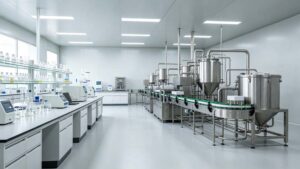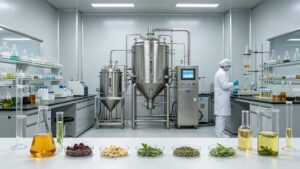
In the dynamic world of botanical extracts, understanding the nuances between chemically related compounds is crucial for formulators, researchers, and procurement specialists. Two such compounds that frequently generate discussion are Phlorizin and Phloretin. While both are dihydrochalcones found in apple trees, they are distinct in structure, function, and application. This article unravels the key differences between Phlorizin and its aglycone form, Phloretin, and highlights why KangPure’s premium Phlorizin extract, sourced from the rich lands of Shaanxi, China, is the superior choice for your formulations.
Understanding the Core Difference: The Glycoside vs. The Aglycone
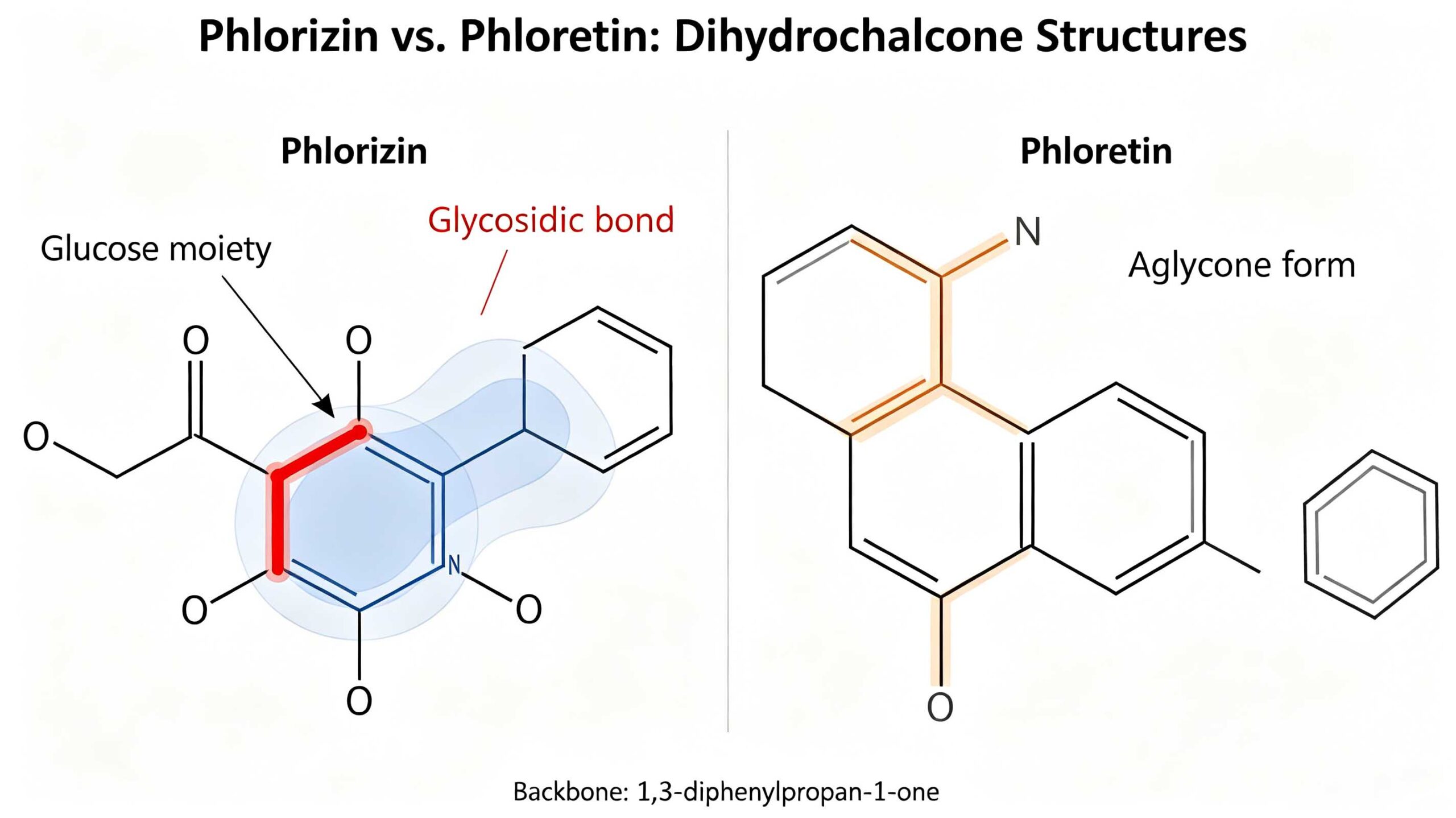
At its heart, the difference between Phlorizin and Phloretin is a matter of molecular structure. Phlorizin (CAS 60-81-1) is a glucoside, meaning it has a glucose molecule attached to its core structure. Phloretin (CAS 60-82-2), on the other hand, is the aglycone—the parent compound without the glucose moiety (Gosch et al., 2010). This single structural difference creates a world of divergence in their biological activities, solubility, and target applications.
Historically, Phlorizin was first isolated from apple tree bark in 1835 (Petersen, 1835). It is the more abundant, naturally occurring storage form in the plant. When ingested, Phlorizin is often metabolized into Phloretin by enzymes in the gut, but as raw materials for nutraceutical and cosmetic products, each offers a unique profile (Ehrenkranz et al., 2005).
Phlorizin vs. Phloretin: A Side-by-Side Comparison
| Feature | Phlorizin | Phloretin |
|---|---|---|
| Chemical Class | Dihydrochalcone Glucoside | Dihydrochalcone (Aglycone) |
| Molecular Weight | 436.41 g/mol | 274.27 g/mol |
| Solubility | Moderately water-soluble due to glucose | Poor water solubility; more lipid-soluble |
| Bioavailability | Requires deglycosylation for absorption | More readily absorbed in the gut |
| Primary Bioactivity | Competitive inhibitor of SGLT1/2 | Inhibits GLUTs, antioxidant, anti-inflammatory |
| Stability | Generally more stable as a glycoside | Can be less stable, more prone to oxidation |
| Main Natural Source | Apple tree bark, unripe apples | Hydrolysis product of Phlorizin |
| Key Applications | Blood sugar management, functional foods | Cosmetics, dietary supplements, preservative |
Why Quality Matters: The KangPure Advantage for Phlorizin
While understanding the difference between Phlorizin and Phloretin is fundamental, the quality of the Phlorizin extract you choose is paramount for product efficacy, safety, and manufacturing consistency. This is where KangPure excels. As a manufacturer based in Shaanxi, China—a region celebrated for its rich agricultural heritage and ideal climate for apple cultivation—we are uniquely positioned to offer superior Phlorizin.
1. Premium Raw Material Sourcing from Shaanxi, China
The journey to exceptional Phlorizin begins with the raw material. KangPure sources its apple raw materials exclusively from Shaanxi Province. This region is known for producing apples with high concentrations of bioactive compounds due to its unique loess soil, altitude, and temperate climate. By controlling the source, we ensure a consistent and potent starting material, which is the first step toward a superior finished product.
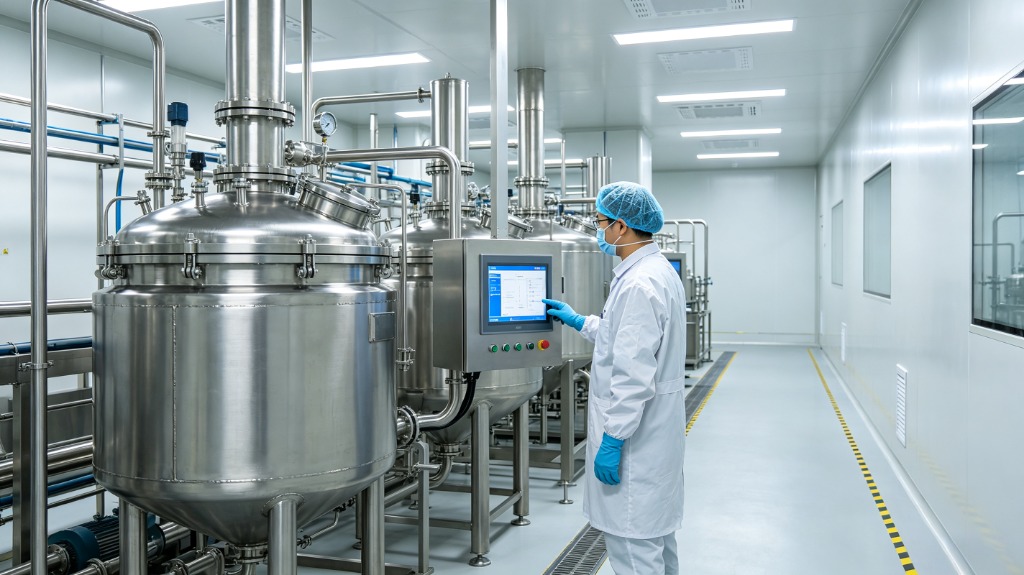
2. Advanced & Standardized Extraction Process
KangPure employs state-of-the-art extraction and purification technologies. Our process is carefully optimized to:
- Maximize the yield of Phlorizin.
- Minimize the degradation of active compounds.
- Produce a product with excellent batch-to-batch consistency.
Our advanced manufacturing capabilities ensure that the glycosidic bond in Phlorizin is preserved, maintaining its unique identity and activity. This stands in contrast to some processes that might inadvertently hydrolyze Phlorizin to Phloretin, altering the final product profile.
3. Rigorous Quality Control & Purity Assurance
Quality is non-negotiable at KangPure. Every batch of our Phlorizin extract undergoes comprehensive testing, including:
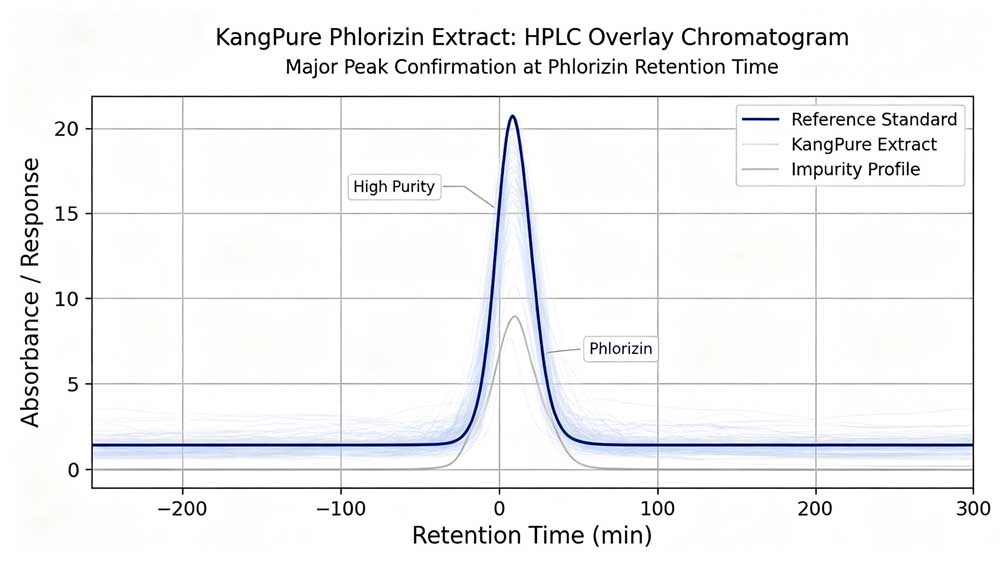
- HPLC Analysis: To verify the exact content of Phlorizin and ensure it meets our high-purity specifications (typically ≥98%).
- Heavy Metals Testing: To ensure safety and compliance with international standards (e.g., USP, EP).
- Microbiological Testing: To guarantee the product is free from harmful pathogens.
- Pesticide Residue Screening: To confirm the absence of unwanted contaminants.
This rigorous quality assurance program provides our customers with the confidence that they are receiving a safe, pure, and reliable ingredient.
4. Key Features & Benefits of KangPure Phlorizin
- High Purity: Available in purities of 90%, 95%, and 98%, meeting the needs of the most demanding applications.
- Consistent Quality: Our ISO, GMP, and HACCP-certified facility ensures every batch meets strict specifications.
- Excellent Solubility: Our extraction process yields a product with good solubility, making it easier to formulate.
- Traceability: From the apple orchards of Shaanxi to your final product, KangPure provides full supply chain transparency.
- Competitive Advantage: By owning the entire supply chain, from raw material to finished extract, we offer cost-effective solutions without compromising on quality.
Applications of Phlorizin Extract
KangPure’s high-quality Phlorizin extract is a versatile ingredient suitable for a wide range of industries:
- Functional Foods & Beverages: As a natural ingredient for managing blood glucose levels, it can be incorporated into dietary supplements, health drinks, and meal replacement products.
- Cosmetics & Personal Care: For its skin-brightening, antioxidant, and anti-aging properties (as it inhibits melanin production).
- Pharmaceutical Intermediates: As a key starting material for the synthesis of certain drug compounds.
- Animal Nutrition: Studied for its potential benefits in metabolic health.
Applications of Phloretin (Briefly)
While our focus is Phlorizin, its aglycone, Phloretin, is also valued, particularly in:
- Advanced Cosmetics: For enhanced skin penetration and use in serums and creams.
- Preservative Systems: Due to its antimicrobial activity.
Why Partner with KangPure?
Choosing KangPure as your Phlorizin supplier means choosing a partner dedicated to excellence. We are not just a manufacturer; we are a team of experts committed to helping you succeed.
- Deep Industry Expertise: Our R&D team has extensive knowledge of botanical extraction and can support your formulation development.
- Reliable Supply Chain: Based in Shaanxi, we have a robust supply chain that ensures consistent raw material availability and on-time delivery.
- Flexible OEM/ODM Services: We offer customized packaging, specifications, and formulations to meet your specific market needs.
- Commitment to Sustainability: We are committed to sustainable sourcing and manufacturing practices that protect the environment.
- Global Reach: We serve clients worldwide, meeting international regulatory requirements with ease.
Conclusion
Understanding the difference between Phlorizin and Phloretin is essential for making informed decisions in product development. Phlorizin, the natural glucoside, offers unique benefits in blood sugar management and functional applications, while Phloretin is prized for its skin benefits.
However, the efficacy and safety of your final product depend critically on the quality of the active ingredient. KangPure, with our premium raw materials sourced from Shaanxi, China, advanced manufacturing, and rigorous quality control, provides the high-purity, reliable Phlorizin extract that modern products demand. By choosing KangPure, you are choosing a partner that prioritizes quality, consistency, and your success.
Contact Us
Ready to learn more about how KangPure’s Phlorizin extract can elevate your products? Contact our team today to request a sample, discuss your specifications, or place an order. Let us be your trusted partner in the botanical ingredients industry.
References
- Ehrenkranz, J. R., Lewis, N. G., Kahn, C. R., & Roth, J. (2005). Phlorizin: a review. Diabetes/Metabolism Research and Reviews, 21(1), 31-38.
- Gosch, C., Halbwirth, H., & Stich, K. (2010). Phloridzin: biosynthesis, distribution and physiological relevance in plants. Phytochemistry, 71(8-9), 838-843.
- Gosch, C., Halbwirth, H., Kuhn, J., Miosic, S., & Stich, K. (2009). Biosynthesis of phloridzin in apple (Malus domestica Borkh.). Plant Science, 176(2), 223-231.
- Petersen, C. (1835). Untersuchung des Phloridzins. Annalen der Pharmacie, 15(2), 178-188.
- Ritschel, W. A., & Hussain, A. (1971). The influence of phlorizin on the intestinal absorption of glucose and galactose. Archives Internationales de Pharmacodynamie et de Thérapie, 191(1), 110-117.
- Zhang, L., et al. (2018). A comprehensive review on the pharmacological potential of phlorizin and its aglycone phloretin. Food & Function, 9(12), 6188-6202.