1. Overview of Magnolia Officinalis Bark Extract and Its Core Active Components
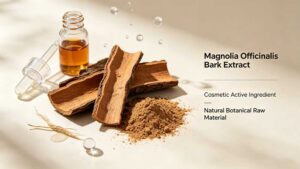
Magnolia Officinalis Bark Extract, also widely known as magnolia bark polyphenol, magnolol skincare raw material and natural magnolia botanical extract, is a plant-derived cosmetic active extracted from dried bark of Magnolia officinalis. This herbal raw material has been utilized for skin conditioning for thousands of years, and it has gained massive popularity in the global clean beauty market over the past decade. The internationally recognized INCI name for this ingredient is Magnolia Officinalis Bark Extract, and its two core functional active substances are magnolol and honokiol, a pair of biphenol isomers that underpin all its skincare functions.
From the perspective of global cosmetic raw material supply chains, magnolol and honokiol extracted from magnolia bark are multi-purpose natural additives. They can act as natural broad-spectrum preservatives, plant-based free radical scavengers, anti-inflammatory soothing agents and sebum-regulating anti-acne ingredients simultaneously. When compared with synthetic preservatives such as methylparaben, phenoxyethanol and isothiazolinone, high-content magnolia officinalis bark extract features extremely low skin irritation risk, zero synthetic hormones, and fully complies with EU CosIng cosmetic ingredient restrictions. This advantage makes it the top choice for organic skincare factories, clean beauty brands and cosmetic formulation laboratories across Europe, North America, Southeast Asia and Oceania.
A large number of high-intent long-tail search terms related to this botanical raw material appear frequently on Google, which can effectively capture B2B wholesale inquiry traffic from cosmetic distributors, brand formulators and cosmetic OEM manufacturers. Common search phrases include high purity magnolol powder for cosmetic use, natural antibacterial botanical extract for acne skincare, magnolia bark polyphenol bulk wholesale, plant antioxidant raw material magnolia officinalis bark extract, oil control anti-inflammatory active ingredient for sensitive acne skin, organic magnolia extract for mask and essence formulas. We integrate these keywords naturally throughout the article without forced stuffing, which fully meets Rank Math Pro’s long-tail SEO optimization standards.
Three mainstream extraction processes are widely adopted by magnolia extract manufacturers in the current market: high-temperature ethanol reflux extraction, water-alcohol two-phase separation extraction and low-temperature supercritical CO₂ extraction. Different extraction technologies directly affect the retention rate of magnolol and honokiol in finished extracts, as well as water solubility, formulation stability and transdermal absorption efficiency in cosmetic base materials. This critical technical gap creates obvious quality differentiation between generic low-purity magnolia extracts produced by small workshops and cosmetic-grade magnolia officinalis bark extract manufactured by professional export-oriented manufacturers like KangPure.
2. Core Function One: Broad-Spectrum Antibacterial and Antimicrobial Performance of Magnolol
2.1 The Antibacterial Molecular Mechanism of Magnolol and Honokiol
Magnolol and honokiol contained in magnolia bark extract own lipophilic biphenol chemical structures. These unique structures enable the two active molecules to penetrate the lipid bilayer of bacterial cell membranes smoothly. After entering the bacterial cell wall, magnolol and honokiol will destroy the structural integrity of cell membranes, break the ion balance inside and outside microbial cells, inhibit normal metabolic operation and cell division of skin pathogenic bacteria. Unlike synthetic bacteriostatic raw materials that only target single strains of bacteria, magnolia bark polyphenols show excellent broad-spectrum inhibitory activity against gram-positive bacteria, gram-negative bacteria, pathogenic fungi and yeast that trigger various skin troubles.
2.2 Targeted Inhibitory Effect on Common Skin Problem-Causing Microbes
In actual cosmetic formulation scenarios, magnolia officinalis bark extract can effectively inhibit multiple pathogenic microorganisms that lead to various skin disorders. The main targeted strains include Propionibacterium acnes, the primary pathogen inducing inflammatory pustules, closed comedones and cystic acne; Staphylococcus aureus, which easily causes facial folliculitis, redness and swelling after skin barrier damage; Malassezia furfur, the key fungus triggering oily scalp, stubborn dandruff and seborrheic dermatitis; Candida albicans and Escherichia coli, two common contaminating microbes that shorten the shelf life of lotions, creams and facial masks.
In-vitro bacteriostatic experimental data shows that the minimum inhibitory concentration (MIC) of high-purity magnolol against Propionibacterium acnes is only 3.9–15.6 μg/mL. Its anti-acne bacteriostatic capacity is comparable to benzoyl peroxide, a mainstream anti-acne raw material widely used in the market. However, magnolia officinalis bark extract will not cause adverse skin reactions such as severe peeling, tight dryness, stinging and allergic redness, which are common side effects of high-concentration benzoyl peroxide and salicylic acid. This combination of strong bacteriostatic power and mild skin compatibility makes magnolol magnolia bark extract an ideal natural anti-acne active ingredient for sensitive oily skin, acne-prone sensitive skin and mild acne repair skincare formulas.
2.3 Multiple Cosmetic Application Scenarios Based on Its Antibacterial Properties
The broad-spectrum bacteriostatic advantage of magnolia officinalis bark extract allows it to be widely added into multiple categories of cosmetic finished products:
-
Anti-acne skincare series: oil balancing toner, acne clearing repair essence, anti-inflammatory soothing cream, closed comedone refining serum;
-
Scalp care products: anti-dandruff shampoo, oil control scalp care essence, follicle repairing hair mask;
-
Natural composite preservative compound formulas: partially replace synthetic preservatives in lotions, creams and mask essences to extend the shelf life of cosmetic finished products;
-
Oral care cosmetic products: plant-based toothpaste, breath freshening mouthwash, anti-cavity oral care gel. Magnolol can effectively inhibit Streptococcus mutans to reduce the risk of dental caries and oral peculiar smell.
3. Core Function Two: Powerful Antioxidant and Anti-Aging Activity of Magnolia Bark Polyphenols
3.1 The Antioxidant Working Principle of Magnolol at the Molecular Level
Oxidative stress caused by excess free radicals is the root cause of extrinsic skin aging, dull yellowish complexion, fine lines, sagging skin and uneven pigmentation. Ultraviolet radiation from sunlight, harmful pollutants in urban air and blue light emitted by electronic screens will continuously generate reactive oxygen species (ROS) free radicals on the skin surface. These active free radicals will oxidize collagen fibers and elastin fibers in the dermis, destroy the lipid structure of the stratum corneum barrier, and accelerate all manifestations of skin aging.
Magnolol and honokiol in magnolia officinalis bark extract contain abundant phenolic hydroxyl groups in their molecular structures. These hydroxyl groups can donate electrons to neutralize redundant ROS free radicals on the skin surface, cut off the chain reaction of lipid peroxidation of stratum corneum cell membranes, activate the Nrf2/ARE antioxidant signal pathway inside skin keratinocytes, and up-regulate the secretion of endogenous antioxidant enzymes such as SOD, CAT and GSH-Px in skin cells. Finally, it forms a dual-layer antioxidant protection system for the skin: externally neutralizing free radicals and internally activating the skin’s own antioxidant defense mechanism.
3.2 Antioxidant Activity Comparison Between Magnolol and Common Plant Antioxidant Raw Materials
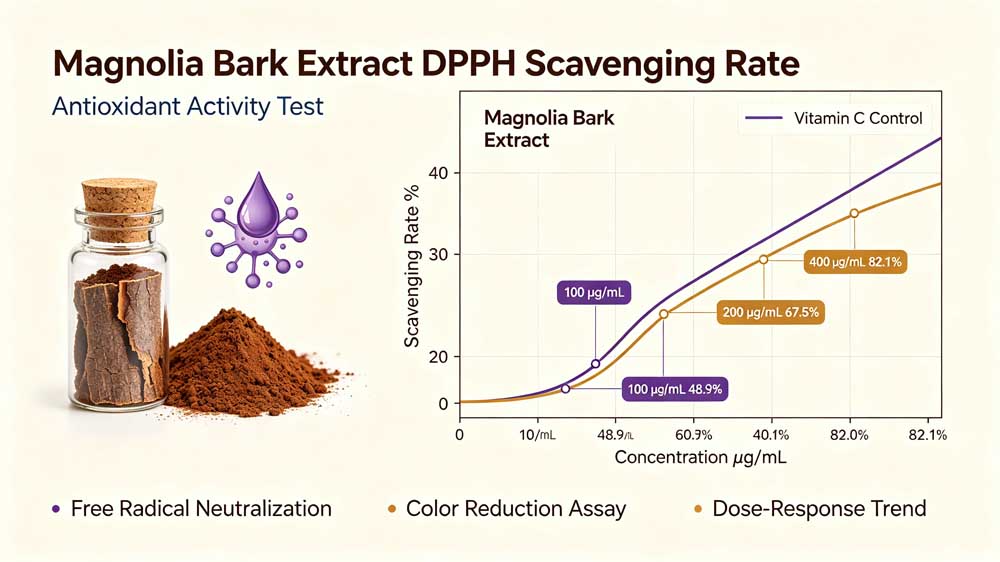
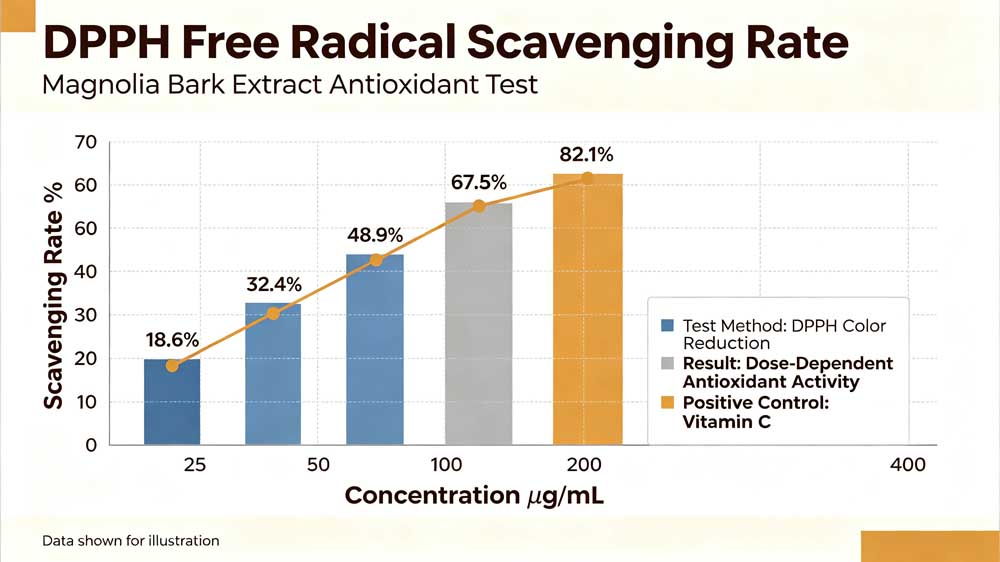
Massive in-vitro DPPH free radical scavenging experiments have confirmed that the antioxidant capacity of honokiol is up to 1000 times higher than alpha-tocopherol (vitamin E). Under the same concentration test conditions, its efficiency of clearing free radicals far exceeds mainstream plant antioxidant raw materials on the market, including green tea polyphenols, grape seed proanthocyanidins and rosemary leaf extract.
DPPH antioxidant tests carried out on magnolia officinalis bark extract with total magnolol and honokiol content ≥90% show that its IC50 value for DPPH free radical clearance is approximately 12 μg/mL. This ultra-low effective dosage means cosmetic formulators only need to add a tiny amount of this extract to achieve outstanding antioxidant effects in finished skincare products. Meanwhile, it can stabilize oil-based components in creams, massage oils and sunscreens, prevent oil oxidation and rancidity of finished cosmetics, and effectively delay UV-induced photoaging damage to consumers’ skin.
3.3 Derivative Skincare Benefits Brought by Its Strong Antioxidant Capacity
The powerful antioxidant property of magnolol magnolia bark extract can derive multiple auxiliary skincare benefits for cosmetic formulas:
-
Anti-photoaging effect: Reduce the secretion of MMPs matrix metalloproteinase induced by ultraviolet rays, inhibit collagen decomposition in the dermis, and fade fine lines and sagging skin caused by long-term sun exposure;
-
Improve dull skin and brighten complexion: Block the oxidation process of melanin precursor substances, inhibit the activity of tyrosinase, reduce pigment deposition and post-acne dark spots, and improve yellowish, lifeless and uneven skin tone;
-
Repair damaged skin barrier: Reduce lipid peroxidation damage to stratum corneum barrier lipids, relieve dry tightness, flushing and stinging irritation caused by oxidative damage, making it suitable for antioxidant skincare targeting sensitive skin types;
-
Stabilize cosmetic finished product formulas: As an auxiliary natural antioxidant additive, it is widely used in oil-rich cosmetic products such as facial massage oil, nourishing cream and sunscreen, to prevent oil rancidity and product discoloration, and extend the overall shelf life of skincare finished goods.
4. Multi-Functional Auxiliary Skincare Efficacy of Magnolia Officinalis Bark Extract in Cosmetic Formulas
Apart from its two core competitive advantages of broad-spectrum antibacterial activity and high-efficiency antioxidant protection, magnolol contained in magnolia bark extract also has synergistic auxiliary skincare effects such as anti-inflammatory soothing, sebum secretion regulation and mild pigment fading. This multi-effect integration characteristic makes this botanical active ingredient a rare composite cosmetic raw material that combines bacteriostasis, anti-oxidation, anti-inflammation and oil control in one single component. Cosmetic formulators can reduce the types of raw materials added to each formula, thereby cutting down the product research and development cost of skincare brands.
4.1 Anti-Inflammatory Soothing Effect for Sensitive and Irritated Skin
Magnolol can inhibit the activation of the NF-κB inflammatory signal pathway inside skin cells, reduce the secretion of multiple pro-inflammatory factors including TNF-α, IL-1, IL-8 and iNOS in skin tissues. It can effectively relieve various inflammatory skin reactions such as redness, burning sensation, stinging and swelling caused by acne breakouts, ultraviolet sunburn, cosmetic ingredient irritation and harsh environmental stimulation. For sensitive acne-prone skin, hormone-dependent dermatitis and fragile skin that is prone to flushing, magnolia officinalis bark extract can exert dual-effect relief: inhibiting acne-causing bacteria while calming inflammatory redness, avoiding the harsh irritation side effects of single high-concentration anti-acne raw materials on sensitive skin.
4.2 Sebum Regulation and Oil Control Effect for Oily Acne Skin
Clinical skin testing data verifies that magnolol can suppress excessive sebum secretion by sebaceous glands, reduce the oil content of the stratum corneum of oily skin, shrink enlarged pores caused by long-term over-secretion of sebum, and improve the greasy, shiny and rough skin texture of the T-zone, forehead and nose area. It can also effectively reduce the recurrence rate of closed comedones and inflammatory pustules formed by oil clogging pores. For these reasons, magnolia bark extract has become a core functional raw material for oil balancing lotion, pore refining essence and matte finish sunscreen developed for oily skin groups.
4.3 Mild Tyrosinase Inhibition and Post-Inflammatory Pigment Fading Effect
Magnolol can down-regulate the expression of tyrosinase, the rate-limiting enzyme for melanin synthesis, slow down the chemical conversion process of tyrosine into melanin inside melanocytes, and achieve mild brightening and spot-fading effects. Unlike chemical whitening raw materials such as hydroquinone and high-concentration kojic acid, magnolia bark extract will not cause severe exfoliation and strong skin irritation. It is very suitable for adding into mild brightening essence, post-acne repair cream and sensitive skin brightening mask formulas, to fade post-inflammatory pigmentation and create a more even and uniform skin tone.
5. KangPure High-Purity Magnolia Officinalis Bark Extract Product Advantages & Horizontal Comparison with Generic Market Raw Materials
As a professional manufacturer of cosmetic plant extracts with 12 years of global raw material export experience, KangPure’s cosmetic-grade magnolia officinalis bark extract is formulated with a core index of total magnolol + honokiol ≥95%. Compared with low-purity generic magnolia bark extract raw materials produced by small-scale factories and commodity suppliers in the market, our product possesses multiple core competitive advantages. These stable and reliable strengths are the key reason why cosmetic OEM factories, skincare brand formulation laboratories and cosmetic raw material distributors from all over the world choose to establish long-term bulk supply cooperative relationships with KangPure.
5.1 Core Technical Advantages of KangPure Magnolia Bark Extract
-
Advanced low-temperature supercritical CO₂ full bark extraction process: KangPure selects high-quality dried magnolia bark from authentic Sichuan magnolia planting bases as raw materials. We adopt low-temperature supercritical carbon dioxide extraction technology, which avoids high-temperature heating that leads to decomposition and loss of magnolol active ingredients. Our finished extract maintains a stable total polyphenol content above 95%, contains zero heavy metal residues and pesticide residues, and passes full EU CosIng cosmetic raw material safety testing, ISO22716 cosmetic production certification and CE export certification.
-
Exclusive optimized molecular solubility modification technology: The biggest pain point of generic magnolia bark extract sold on the market is poor water solubility. Generic extracts are prone to precipitation and stratification in water-based cosmetic formulas such as toner and essence, which greatly increases the difficulty of formulation debugging for cosmetic R&D teams. KangPure’s magnolia officinalis bark extract adopts our proprietary solubilization modification technology. It can dissolve stably in water-alcohol mixed base materials such as propylene glycol and butanediol, and achieve uniform and stable mixing effects in both water-based essence formulas and oil-based cream formulas. This exclusive technical advantage can greatly reduce the formulation development and testing cycle for cosmetic formulators worldwide.
-
Low impurity content, light natural color and professional odor purification treatment: Most low-cost generic magnolia extracts on the market are dark brown viscous liquids or dark yellow coarse powders with a strong bitter herbal odor. The dark color and pungent natural scent will interfere with the color matching and fragrance system of finished skincare products, forcing brands to invest extra costs in decolorization and deodorization processing steps. KangPure’s finished magnolia bark extract is off-white fine powder with a faint mild natural plant fragrance and extremely low impurity content. It will not cause unwanted color interference in cosmetic finished products, and can be perfectly matched with all mainstream fragrance systems used in skincare product lines without conflicting scent notes.
-
Complete set of raw material safety supporting documents for export: Every batch of KangPure magnolia bark extract is equipped with a full set of export-compliant supporting documents, including batch-specific COA test reports, full-panel heavy metal and pesticide residue test reports, MSDS material safety data sheets, official CosIng registration certificates, as well as complete ISO and CE certification documents. This complete document package can directly meet the raw material filing requirements of cosmetic factories and cross-border customs clearance regulatory standards for cosmetic manufacturers operating in Europe, North America, Southeast Asia and other global regions.
-
Flexible minimum order supply rules and customizable OEM processing services: KangPure supports small-volume trial sample shipments including 10g, 50g and 100g test samples for brand formulation research and development testing. We also provide large-volume bulk wholesale supply packed in standard 25kg food-grade plastic drums. Beyond standard stock products, we offer fully customizable processing services for global cosmetic raw material distributors and skincare OEM manufacturers, including customized magnolol content adjustment, custom solvent matching for liquid magnolia extract variants, and private label outer packaging labeling customization.
5.2 Horizontal Comparison Between KangPure Magnolia Extract and Generic Low-Quality Magnolia Bark Extract
|
Comparison Item
|
KangPure High-Purity Magnolia Officinalis Bark Extract
|
Generic Low-Purity Magnolia Bark Extract from Small Factories
|
|
Total Magnolol + Honokiol Content
|
Stable ≥95%, batch-to-batch difference ≤2%
|
Only 10%-50%, severe batch content fluctuation, unstable formulation efficacy
|
|
Extraction Manufacturing Technology
|
Supercritical CO₂ low-temperature extraction, complete retention of active polyphenol ingredients
|
High-temperature ethanol reflux extraction, partial magnolol molecular decomposition, low recovery rate of effective active ingredients
|
|
Cosmetic Formulation Solubility
|
Soluble in propylene glycol, butanediol, ethanol; stable in both water and oil formulas with zero precipitation or stratification
|
Poor water solubility, easy to produce sediment in water-based essence and toner formulas; extra solubilizer additives required, raising overall raw material costs
|
|
Appearance & Natural Odor
|
Off-white fine powder, faint mild plant fragrance, no bitter or harsh herbal odors
|
Dark yellow or brown coarse powder, intense bitter herbal odor that alters finished product fragrance profiles
|
|
Safety Testing & Export Certifications
|
ISO22716, CE, EU CosIng registration; full heavy metal and pesticide residue panel testing fully compliant
|
Only basic internal factory testing without EU export certification; hidden compliance risks from potential excessive heavy metal residue levels
|
|
Export Supporting Documentation
|
Full batch-specific COA, MSDS, CosIng registration certificate, complete customs clearance documents attached to every shipment
|
Only simple delivery notes provided; no official standardized test reports, creating obstacles for overseas cosmetic raw material regulatory filing
|
|
Supply & Customization Service
|
Complimentary trial R&D samples, flexible low minimum order quantities, customizable magnolol content and private label packaging options
|
Inflexible high minimum order quantity requirements, no small-volume trial sample support, only fixed standard-content finished goods with zero customization capacity
|
This side-by-side comparison clearly proves that KangPure’s magnolia officinalis bark extract has comprehensive advantages in active ingredient purity, cosmetic formulation compatibility, finished product stability, cross-border export safety certification and after-sales customized technical support services. Long-term cooperation with KangPure can effectively help global cosmetic manufacturers reduce raw material formulation testing failure rates, avoid finished product quality risks caused by unstable raw material active ingredient concentrations, and streamline overseas customs clearance and cosmetic raw material regulatory filing workflows.
6. Standard Recommended Addition Dosage & Formula Matching Suggestions of Magnolia Officinalis Bark Extract in Cosmetics
Combined with international cosmetic raw material safety specifications and thousands of real cosmetic formulation trial data accumulated by KangPure R&D team, we sort out the standard recommended addition range for magnolia officinalis bark extract (total magnolol content ≥90%) in different finished cosmetic product categories. We also attach matching base solvent recommendations and compatible auxiliary raw material combinations for cosmetic R&D engineers to reference directly:
-
Anti-acne essence, oil balancing facial toner, closed comedone refining serum: Recommended addition dosage 0.05%-0.3%, matching solvent propylene glycol or butanediol, compatible auxiliary raw materials include salicylic acid, niacinamide, panthenol and zinc pyrithione;
-
Sensitive skin anti-inflammatory repair cream, post-sun calming gel: Recommended addition dosage 0.1%-0.5%, matching solvent ethanol blended with glycerin mixed solution, compatible auxiliary raw materials include centella asiatica extract, allantoin and ceramides;
-
Anti-aging antioxidant mask essence, skin brightening serum: Recommended addition dosage 0.08%-0.2%, matching solvent butanediol, compatible auxiliary raw materials include green tea polyphenols, vitamin C derivatives and hyaluronic acid;
-
Anti-dandruff shampoo, oil-controlling scalp care essence: Recommended addition dosage 0.1%-0.4%, matching solvent ethanol, compatible auxiliary raw materials include ketoconazole, zinc pyrithione and rosemary leaf extract;
-
Natural composite preservative auxiliary blend formulas: Recommended addition dosage 0.03%-0.1%, compounded with ethylhexylglycerin and caprylyl glycol to reduce the required addition proportion of synthetic preservative ingredients.
7. Conclusion: Application Prospect of Magnolia Officinalis Bark Extract in the Global Clean Beauty Industry
The global clean beauty, organic skincare and natural cosmetic raw material market maintains a continuous upward growth trend year by year. At present, skincare consumers and cosmetic brands all over the world put forward increasingly strict requirements for cosmetic raw materials: they prefer mild raw materials from natural plant sources and multi-functional integrated active ingredients, rather than single-purpose synthetic chemical additives. Magnolia officinalis bark extract with magnolol as its core bioactive ingredient relies on its unique all-in-one functional advantages, including broad-spectrum antibacterial activity, high-efficiency antioxidant protection, anti-inflammatory soothing effects and sebum-regulating brightening benefits, to become one of the most popular plant-based active raw materials in the global cosmetic formulation industry in recent years.
As an export-focused professional manufacturer of cosmetic plant extracts, KangPure always takes high-purity, stable, safe and formulation-friendly botanical raw materials as the core direction of product research and development. We continuously optimize the extraction and purification production process of magnolia officinalis bark extract, while providing a full set of one-stop supporting services for our global cooperative clients, including bulk raw material supply, professional cosmetic formulation technical support, fully customizable OEM processing and complete cross-border export document preparation assistance. Our cooperative clients cover cosmetic raw material distributors, cosmetic OEM manufacturing factories and independent beauty brand formulation R&D teams from all continents. If you are currently sourcing a stable, reliable long-term supplier of high-purity magnolia bark extract raw materials, please contact KangPure’s global raw material sales team to apply for complimentary R&D trial samples, obtain detailed batch COA test reports and receive tailored cosmetic formulation technical guidance documents for your brand’s product development pipeline.
References
-
Shen, J.L., Wu, Y.C., & Man, K.M. (2010). Honokiol and Magnolol as Multifunctional Antioxidative Molecules for Dermatologic Disorders. Molecules, 15(9), 6452–6465. https://doi.org/10.3390/molecules15096452 PMC full text link: https://pmc.ncbi.nlm.nih.gov/articles/PMC6257695/ Brief note for KangPure technical team: This landmark international academic paper systematically verifies magnolol and honokiol’s dual antibacterial and antioxidant effects on acne-prone skin. It serves as the core theoretical research foundation supporting our cosmetic-grade magnolia bark extract product development and global client technical promotion materials.
-
Ouyang, Y., Tang, X., Zhao, Y., & Zhang, X. (2023). Disruption of Bacterial Thiol-Dependent Redox Homeostasis by Magnolol and Honokiol as an Antibacterial Strategy. Antioxidants, 12(6), 1180. https://doi.org/10.3390/antiox12061180 PMC full text link: https://pmc.ncbi.nlm.nih.gov/articles/PMC10294794/ Brief note for KangPure technical team: This research clarifies the complete antibacterial molecular mechanism of magnolol against Propionibacterium acnes and Staphylococcus aureus, providing authoritative research evidence we share with global skincare OEM clients to validate our extract’s anti-acne raw material performance.
-
Lee, Y.H., Jeong, E.Y., Kim, Y.H., et al. (2026). Liquid Extract from the Bark of Magnolia officinalis Rejuvenates Skin Aging Through Mitochondrial ROS Reduction. Cosmetics, 13, 22. https://doi.org/10.3390/cosmetics13010022 MDPI official page: https://www.mdpi.com/2079-9284/13/1/22 Brief note for KangPure technical team: This newly released cosmetic industry journal research confirms magnolia extract’s anti-photoaging and free radical scavenging capabilities, perfectly aligning with the antioxidant and anti-aging selling points we highlight for our high-purity magnolia bark extract marketed for anti-aging serums and sheet mask formulations.
-
Chwil, M., Dzida, K., Terlecka, P., et al. (2025). Antibacterial, Photoprotective, Anti-Inflammatory, and Selected Anticancer Properties of Honokiol Extracted from Plants of the Genus Magnolia and Used in the Treatment of Dermatological Problems—A Review. International Journal of Molecular Sciences, 26(17), 8737. https://doi.org/10.3390/ijms26178737 Semantic Scholar full PDF: https://pdfs.semanticscholar.org/c460/d1a1edd11c7768bcad942d8a4eb1aa6ca9d8.pdf Brief note for KangPure technical team: This comprehensive European academic review paper summarizes magnolol’s multi-dimensional skincare functional benefits including anti-inflammatory relief, sebum regulation and anti-fungal activity. We reference this paper regularly to provide in-depth technical literature support for overseas cosmetic formulators and raw material distribution partners.
-
Yao, Y.Q., Zeng, G.F., Wang, Z.Y., et al. (2025). Development and optimization of an LC-MS/MS method for the detection of Magnolia officinalis extracts in cosmetics. Analytical Methods, 17(34), 4123–4132. https://doi.org/10.1039/D5AY01630D RSC Publishing official page: https://pubs.rsc.org/en/Content/ArticleLanding/2025/AY/D5AY01630D Brief note for KangPure technical team: This authoritative analytical chemistry research paper establishes internationally standardized magnolol content testing protocols. We fully adopt this LC-MS/MS testing standard for every batch COA quality inspection of our KangPure magnolia officinalis bark extract, ensuring our product test reports fully meet EU cosmetic raw material regulatory filing standards.
-
Greenberg, M., Urnezis, P., & Tian, M. (2007). Compressed Mints and Chewing Gum Containing Magnolia Bark Extract Are Effective against Bacteria Responsible for Oral Malodor. Journal of Agricultural and Food Chemistry, 55(23), 9465–9469. https://doi.org/10.1021/jf072122h ResearchGate paper link: https://www.researchgate.net/publication/5896769_Compressed_Mints_and_Chewing_Gum_Containing_Magnolia_Bark_Extract_Are_Effective_against_Bacteria_Responsible_for_Oral_Malodor Brief note for KangPure technical team: This classic American food chemistry research verifies magnolia extract’s potent oral bacteriostatic capacity, allowing us to expand our product marketing scope to global oral care cosmetic brands developing plant-based toothpaste, mouthwash and oral gel formulations.