Introduction
With the continuous growth of the global organic food, dietary supplement and natural beauty markets, organic green tea powder has become a popular botanical raw material for cross-border procurement. However, the quality of organic green tea powder on the market varies greatly. Many products are labeled “organic” without formal qualifications, accompanied by problems such as excessive pesticide residues, ingredient adulteration and insufficient active content, which easily cause export returns, customs detention and unqualified market inspections for brand owners. As a professional plant extract source factory KangPure, based on years of foreign trade export experience, this article explains in detail the organic certification grade classification methods, core selection criteria and common procurement pitfalls, helping global buyers screen high-quality suppliers and avoid cooperation risks.
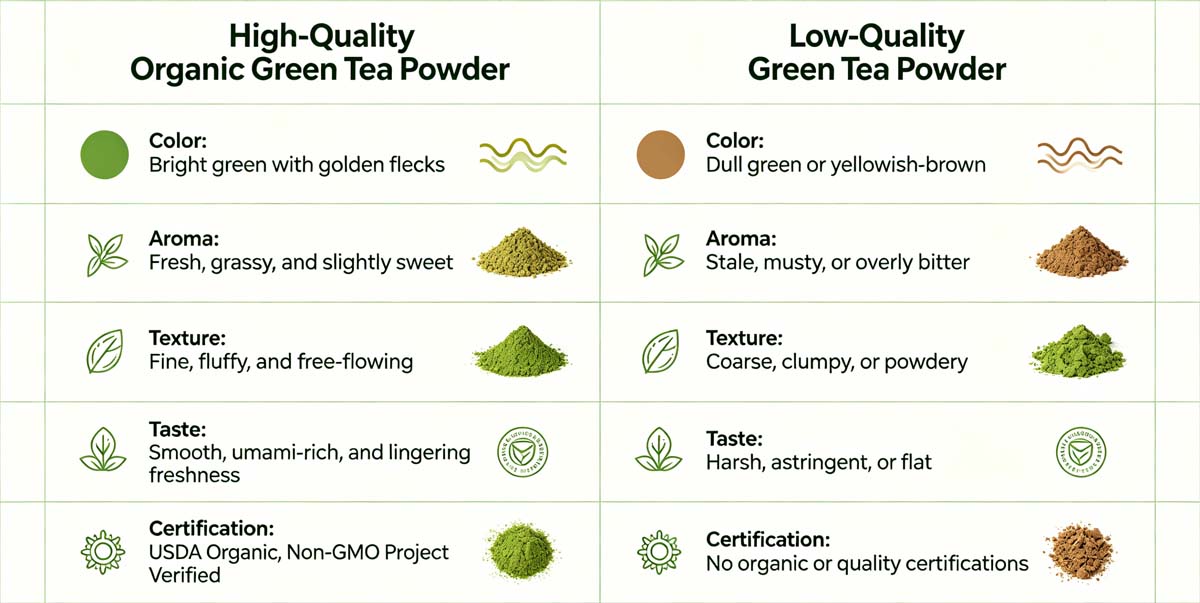
The core standard to judge the authenticity of organic green tea powder is authoritative organic certification. Different certifications correspond to different market access permissions and serve as the key grading basis for foreign trade procurement. At present, there are three globally recognized and universal formal certifications with clear recognition levels from high to low.
1. EU Organic Certification (Highest Recognition) As the most stringent global organic food certification, it has extremely high requirements for soil environment, planting control, processing procedures, pesticide residues and heavy metal indicators. It is a rigid threshold for entering high-end markets in the EU, Australia and the Middle East, with recognition covering most countries worldwide.
2. USDA Organic Certification (Mandatory for North American Markets) It is the highest universal standard for the North American market, with strict control over raw material traceability, zero chemical additives and zero excessive pesticide residues. It is an essential qualification for products entering supermarkets and cross-border e-commerce platforms in the United States and Canada.
3. China Organic Certification (Domestic Compliance Basis) It complies with domestic organic production standards, suitable for domestic sales and ordinary Southeast Asian foreign trade orders. Holding only this certification cannot support customs clearance for high-end European and American organic markets.
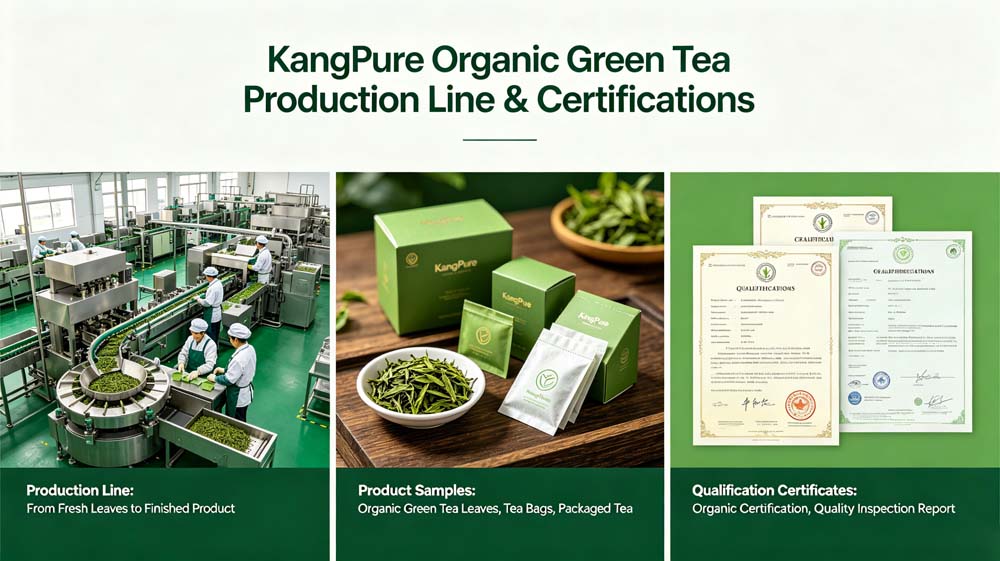
KangPure organic green tea powder is equipped with EU, USDA and China triple organic certifications, with full qualification coverage to meet export compliance requirements of different global regions.
Core Selection Criteria for High-Quality Organic Green Tea Powder
In addition to certification qualifications, buyers need to conduct comprehensive screening from four dimensions: raw materials, technology, ingredients and testing, to avoid purchasing fake organic and low-activity inferior raw materials.
1. Raw Material Traceability Standard High-quality organic green tea powder must have a complete traceability system. Raw materials are sourced from organic tea gardens with three-year soil purification, free of chemical fertilizers, pesticides and heavy metal pollution, and traceability reports are available for each batch. Reject bulk raw materials with unclear sources and mixed harvesting.
2. Production Technology Standard High-quality products adopt low-temperature fixation and low-temperature ultra-fine grinding technology to maximize the retention of core active ingredients such as tea polyphenols and EGCG. All products are produced in a 100,000-class dust-free workshop with no sucrose, no essence and no fillers, ensuring pure purity. High-temperature mass production technology seriously loses active ingredients, which is a common problem of low-grade organic green tea powder.
3. Ingredient and Mesh Standard High-end foreign trade procurement prioritizes finished products with high EGCG content for higher activity and stronger application value. The mesh size can be customized from 200 to 1200 mesh with delicate, uniform, lump-free and impurity-free powder, suitable for beverages, baking, skincare and dietary supplements.
4. Authoritative Testing Standard Each batch of products shall provide third-party test reports covering key indicators such as pesticide residues, heavy metals, microorganisms and active ingredient content, fully complying with FDA and EU food testing standards to support cross-border random inspections.
Common Procurement Pitfall Avoidance Guide
The foreign trade market is flooded with a large number of fake organic green tea powder. Buyers should focus on avoiding the following four common pitfalls.
1. Fake Certification Pitfall Some merchants use expired certificates, borrow qualifications from other factories, or use ordinary domestic food certifications to pretend to be organic certifications, which cannot pass European and American customs verification. Purchasers must verify three conditions: valid certificate period, consistent factory subject and official website queryable.
2. Adulteration and Dilution Pitfall Low-grade products are mixed with starch, maltodextrin and green tea residue powder to reduce costs, resulting in greatly reduced active ingredients, weak taste and turbid color, failing to meet the production needs of high-end formulas.
3. Excessive Pesticide Residue Pitfall Non-source suppliers have mixed product sources, and raw materials do not undergo soil purification and strict pesticide residue screening. Although the price is low, it is very likely to cause excessive inspection results in European and American markets, resulting in huge losses.
4. No Traceability and No Batch Record Pitfall Bulk goods without batch reports and traceability information cannot cope with overseas compliance reviews, and no accountability or after-sales support is available once problems occur.
FAQ | Procurement Frequently Asked Questions
Q1: Is China organic certification enough for exports to Europe and America?
A: No. China organic certification is only applicable to China and some Southeast Asian markets. Valid USDA or EU organic certification is mandatory for exports to Europe and America.
Q2: How to quickly identify adulterated organic green tea powder?
A: Prioritize the verification of triple certifications and third-party ingredient test reports, and check powder color and solubility. Pure organic green tea powder has a natural color, uniform solubility and no precipitated impurities.
Q3: Does higher mesh size mean better organic green tea powder quality?
A: Not exactly. Product quality mainly depends on raw materials and active ingredients. Mesh size only affects application scenarios, and the fineness can be customized according to formula requirements.
KangPure Procurement & Cooperation Advantages
As a professional source manufacturer focusing on plant extracts, KangPure independently controls the whole process from organic tea garden planting and dust-free production and processing to finished product testing. All organic green tea powder holds valid EU, USDA and China triple organic certifications, with complete test reports, traceability documents and customs clearance materials for each batch. We support 200–1200 mesh customization, bulk wholesale, small-batch sample testing and large-scale OEM production. We strictly eliminate adulteration, excessive pesticide residues and insufficient activity, providing stable, compliant and high-quality organic green tea powder raw material solutions for global buyers.