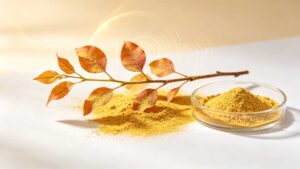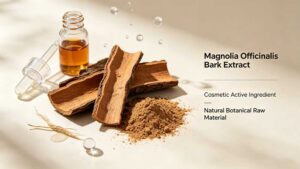
In the past five years, the global longevity-ingredient pipeline has quietly shifted from resveratrol and quercetin toward a narrower, more mechanistic class: senolytic flavonoids. Among them, fisetin (3,3′,4′,7-tetrahydroxyflavone) isolated from Cotinus coggygriaScop. (Eurasian smoketree ) has moved from a strawberry-coexisting trace polyphenol to a standalone bulk active with published mouse-lifespan data, sheep translational studies, and 2025 peer-reviewed work on diabetic vascular aging.
This article is written for formulators, private-label buyers, and R&D procurement in the nutraceutical and cosmeceutical trade. We cover botany, chemistry, mechanism, specification pitfalls, and where KangPure’s Cotinus coggygria extract fisetin sits against commodity-grade 98% powder.
Botanical identity: why Cotinus coggygriaand not just “strawberry extract”
Fisetin occurs in strawberries, apples, persimmons, onions, and Ginkgo leaf, but the commercial dry-weight concentration in fruit is low (µg/g level). The smoketree stem/wood delivers a tractable starting matrix for industrial flavonoid recovery, which is why the INCI/botanical label “Cotinus coggygriaextract” dominates B2B catalogs.
Key botanical facts for documentation:
Latin: Cotinus coggygriaScop. (syn. Rhus cotinus), Anacardiaceae
Used part: stem wood / young branch (not leaf-only, contrary to some retail copy)
Active marker: fisetin CAS 528-48-3, C₁₅H₁₀O₆, MW 286.24
Natural co-occurrences: gallic acid derivatives, sulfuretin, but fisetin is the HPLC-tracked marker
For a buyer, “fisetin from strawberry” is marketing; “fisetin from Cotinus coggygriastem, HPLC 98.0%+” is a defensible specification.
Physicochemical profile and the bioavailability problem nobody ignores
Fisetin is a yellow to pale-yellow crystalline flavonol, lipophilic, practically insoluble in water, sparingly soluble in methanol/DMSO, freely soluble in ethanol and warm ethyl acetate. Melting point >330 °C (dec.).
Two formulation realities drive purchasing decisions in the West. First, poor aqueous solubility makes this ingredient capsule and dry-blend friendly, but beverage suspension requires emulsification or cyclodextrin complexation. Second, moderate oral bioavailability means that human supplemental capsules typically run 100–500 mg per unit, often paired with phospholipids or delivered as a micronized powder.
This is exactly where raw-material engineering matters. A 98% HPLC powder with D90 = 40 µm and one with D90 < 10 µm (air-jet micronized) are not the same ingredient on a dissolution curve, even if COA numbers appear identical on paper.
Mechanistic layering: antioxidant, anti-inflammatory, senolytic
The reason fisetin outperforms classic ascorbic acid or α-tocopherol in longevity literature is multi-pathway concurrency.
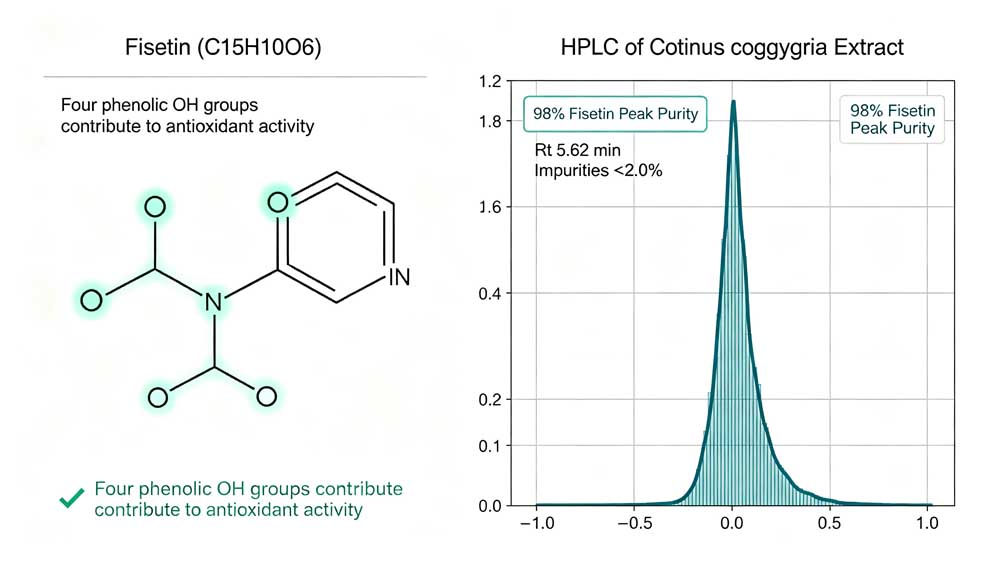
Direct ROS scavenging remains its baseline strength. Four phenolic hydroxyls donate electrons and protons to superoxide, DPPH, and peroxynitrite. In cell-free assays, fisetin’s TEAC and ORAC values often sit above quercetin in several reports, though absolute numbers vary by assay pH. However, the real value lies in indirect antioxidant gene activation. Fisetin activates the Nrf2/ARE pathway, upregulating SOD, CAT, GPx, and heme oxygenase-1. This builds endogenous defense rather than only consuming itself—unlike vitamin C which is spent after one redox cycle.
On the inflammatory front, fisetin suppresses NF-κB signaling by inhibiting IκBα phosphorylation and downstream TNF-α/IL-6 production. This lowers the senescence-associated secretory phenotype (SASP) burden, effectively bridging the gap between “antioxidant” and “anti-aging” claims.
The headline mechanism, however, is senolytic selectivity. Mayo Clinic screening of ten flavonoids placed fisetin as the most potent senolytic among tested natural polyphenols, selectively inducing apoptosis in senescent HUVECs and preadipocytes via Bcl-2/Bcl-xL and PI3K-Akt modulation while sparing proliferating cells. Yousefzadeh et al. demonstrated that late-life intermittent fisetin administration in mice reduced p16ᴵᴺᴷ⁴ᵃ tissue burden, improved histopathology, and extended median and maximum lifespan. More recently, a 2025 publication in Phytotherapy Researchextended these findings to diabetic aortic aging, clarifying the PI3K-Akt-Bcl-2/Bcl-xL axis in clearing vascular senescent cells.
Neuroprotection and skin health round out the application scope. Fisetin is lipophilic enough to cross the blood-brain barrier; Salk Institute work shows cognitive protection in senescence-accelerated mice. In dermal models, fisetin reduces UV-B induced MMP-1 expression and preserves collagen type I synthesis—highly relevant for cosmeceutical anti-photoaging blends.
what “98% fisetin” hides
Commodity COAs from many suppliers show a familiar pattern: Assay ≥98.0% HPLC, Loss on drying ≤5%, Pb ≤2 ppm, As ≤2 ppm, 80-mesh pass, and “Yellow powder.” That is necessary but not sufficient for a Western-facing brand. The gaps become apparent under audit.
KangPure approaches specifications differently. While a commodity 98% powder might originate from an unspecified blend of Rhusspecies, KangPure’s Cotinus coggygria extract fisetin is sourced exclusively from single-origin smoketree stem, with full batch-lot botanical traceability. Where standard offerings skip micronization, we offer optional air-jet milling to achieve D90 < 10 µm, directly addressing dissolution limitations. Our HPLC validation uses dual-wavelength monitoring to separate fisetin from structural analogs like sulfuretin—a detail often missed in budget-grade testing.
Solvent residue profiles extend beyond ethanol declarations to include a full ICH Q3C Class 1/2 screen upon request. Heavy metal panels cover Pb, As, Cd, and Hg, with total metals kept under 10 ppm. Microbiological testing exceeds USP 61/62 basics, targeting total yeasts <20 cfu/g and confirming absence of Bacillus cereus. Documentation packages include COA, TDS, allergen statements, and Non-GMO declarations as standard, with Kosher and Vegan certifications readily available. Most importantly, every lot carries a farm-to-drum code tied to export customs records, eliminating the ambiguity of generic “China herb market” sourcing.
KangPure does not claim its fisetin “cures aging.” We supply the standardized active with documentation that survives EU and US label audits. For brands building a senolytic stack—pairing fisetin with quercetin or apigenin—batch-to-batch assay stability within ±0.3% matters far more than a marginal price cut on inconsistent material.
Application formats and dose translation
Published animal efficacious ranges typically fall between 10–100 mg/kg body weight, administered intermittently or chronically. Human supplemental products generally feature 100 mg, 250 mg, or 500 mg of fisetin per capsule, often cycled. Some protocols borrow the “2 days per month” high-dose model from dasatinib-plus-quercetin research, although fisetin-only human clinical protocols remain under investigation.
Typical B2B use cases include longevity capsules and tablets formulated with 98% powder at 100–300 mg per unit, powder sachets blended with lecithin or piperine for perceived uptake enhancement, and functional beverages requiring micellar or β-cyclodextrin inclusion due to the native powder’s hydrophobicity. Anti-aging creams incorporate 0.1–0.5% fisetin in the lipid phase, frequently paired with ferulic acid. An emerging niche includes pet and livestock oxidative-stress supplements, particularly for senior canine applications.
KangPure supports this diversity with tiered concentrations: 10%, 50%, 90%, and 98% HPLC grades all derived from the same botanical lineage. The 10% grade serves cost-sensitive beverage premixes, while 98% remains the gold standard for encapsulated hero SKUs.
Regulatory posture
Fisetin is not a pharmaceutical. In the United States, it is marketed as a dietary ingredient, though New Dietary Ingredient (NDI) notifications have not been universally filed by all suppliers—a critical caveat for buyers. In the European Union, its status falls under novel-food regulations depending on dosage and history of consumption. KangPure provides export-oriented documentation only; we do not draft structure or function claims for customer labels. This separation ensures your brand remains compliant and our manufacturing facility stays audit-ready.
Why buyers switch to KangPure for Cotinus coggygria fisetin
International buyers consolidate suppliers for three practical reasons. First, botanical integrity: KangPure guarantees fisetin from Cotinus coggygria, not diluted blends of mixed fruit extracts. Second, process control: micronization is available on demand under the same SKU, preventing unexpected reformulation challenges. Third, documentation reliability: pre-shipment COAs in English, full metal and pesticide panels on request, and rapid response times replace post-complaint troubleshooting.
Minimum order quantities are structured for flexibility: 1 kg trial packs for laboratory formulation, 25 kg drums for private-label launches, and 100 kg+ contract milling for established brands. Cross-reference support is part of the service—we provide the international citations your regulatory consultants expect, anchored in PubMed-indexed research rather than generic marketing claims.
Against synthetically produced fisetin, which remains rare, expensive, and often rejected by clean-label consumers, KangPure maintains a botanical focus. Against low-cost 98% “yellow powders” with vague botanical origins and no micronization, we accept a slimmer margin in exchange for audit survival and long-term partnership stability.
Sourcing conversation: what we need from you
To generate an accurate quotation, we ask overseas buyers for five details: target assay (90% or 98% HPLC) and particle-size expectations, destination market (US DSHEA, EU EFSA, Gulf states, or Asia-Pacific), required certifications (Halal, Kosher, Non-GMO, ISO22000, cGMP audit readiness), pack size and annual volume bands, and whether you require private-label tablet or capsule tolling versus bulk powder only.
KangPure responds with a draft COA, confirmed lead time from our Xi’an warehouse, and clear shipping Incoterms—FOB Shanghai, CIF Rotterdam, or DAP to your door. We do not disappear after sample shipment; technical follow-up on dissolution performance and blend compatibility is integral to our service model.
Closing note for formulators
The fisetin story has matured beyond “a flavonoid that scores well in ORAC.” It is now recognized as a senotherapeutic with mammalian lifespan data, 2025-confirmed benefits in vascular aging, and a clearly defined mechanism for senescent-cell apoptosis. But the molecule is only as effective as the powder you tableted. Botanical origin, crystal size, solvent residuals, and HPLC marker integrity determine whether your 250 mg capsule is a credible longevity product or merely a yellow filler.
If your team is shortlisting Cotinus coggygriaextract fisetin suppliers for 2026 SKUs, send us the spec sheet you already received from another vendor. KangPure will benchmark it line-by-line and ship a 50 g laboratory sample of the matching grade within five working days.
References (international, non-China based publications)
- Khan N, Syed DN, Ahmad N, Mukhtar H. Fisetin: a dietary antioxidant for health promotion.Antioxid Redox Signal. 2013;19(2):151-162. PMID: 22913251.
- Zhu Y, Doornebal EJ, Pirtskhalava T, et al. New agents that target senescent cells: the flavone fisetin and BCL-XL inhibitors A1331852 and A1155463.Aging (Albany NY). 2017;9(3):955-963. PMID: 28273655.
- Chahal SK, Kabra A, Saeedan AS, Ansari MN. Fisetin: a multitarget flavonol bridging oxidative stress, inflammation, aging, and cancer.Naunyn Schmiedebergs Arch Pharmacol. 2026;399(6):7877-7899. PMID: 41538057.
- Yousefzadeh MJ, Zhu Y, McGowan SI, et al. Fisetin is a senotherapeutic that extends health and lifespan.EBioMedicine. 2018;36:18-28. PMID: 30279100.
- Huard CA, Gao X, Dey Hazra ME, et al. Effects of fisetin treatment on cellular senescence of various tissues and organs of old sheep.Antioxidants (Basel). 2023;12(8):1646. PMID: 37627641.