
In the rapidly growing market for sensitive skin and anti-inflammatory skincare, few natural actives offer the scientific validation and clinical efficacy of Tetrandrine. Derived from the root of Stephania tetrandra (known as Fangji in traditional Chinese medicine), this bis-benzylisoquinoline alkaloid has been used for over 2,000 years in traditional medicine for its anti-inflammatory and immunomodulatory properties. Today, modern science has validated tetrandrine’s exceptional potential as a skincare ingredient for addressing atopic dermatitis, psoriasis, allergic reactions, and skin barrier dysfunction. With purity levels reaching 98%, tetrandrine offers a potent, non-hormonal, and safe alternative to corticosteroids for soothing irritated, inflamed, and sensitive skin. This article provides a comprehensive scientific overview of tetrandrine’s anti-inflammatory, anti-allergy, and barrier-repair mechanisms, formulation considerations, and why KangPure’s premium 98% tetrandrine extract, sourced from high-quality Stephania tetrandra in Shaanxi, China, is the superior choice for high-end skincare brands.
I. Understanding 98% Tetrandrine: A Time-Honored Natural Alkaloid
1. Chemical Profile and Natural Source
Tetrandrine (CAS: 518-34-3, Molecular Formula: C38H42N2O6, Molecular Weight: 622.75 g/mol) is a bis-benzylisoquinoline alkaloid predominantly found in the root of Stephania tetrandra S. Moore, a plant belonging to the Menispermaceae family. The compound is known for its characteristic colorless needle-like crystalline structure and lipophilic nature.
Key properties of high-purity tetrandrine include:
- Appearance: Off-white to white crystalline powder
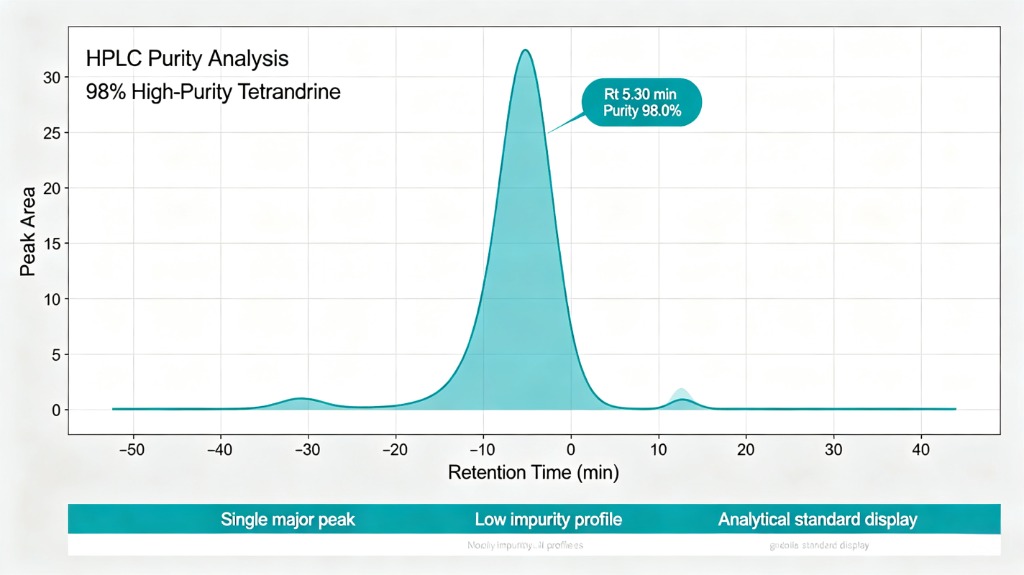
- Purity: ≥98% (HPLC)
- Molecular Weight: 622.75 g/mol
- Log P: 3.55 (lipophilic, poorly water-soluble)
- Detection Method: HPLC
Historically documented in the Shennong Bencao Jing (The Divine Farmer’s Materia Medica), Stephania tetrandra has been used for over 2,000 years in traditional Chinese medicine to treat rheumatic pain, edema, and inflammatory skin conditions. In modern pharmacopoeia, tetrandrine has been approved for treating silicosis and rheumatoid arthritis in China and Japan, underscoring its well-established safety and efficacy profile.
Image 1 Placeholder
images1:Chemical structure of Tetrandrine (C38H42N2O6), a bis-benzylisoquinoline alkaloid from Stephania tetrandra root. Clear 2D structural formula highlighting the bis-benzylisoquinoline backbone, scientific illustration style with labels.
建议文件名: tetrandrine-chemical-structure-formula.jpg
II. Anti-Inflammatory, Anti-Allergy, and Barrier-Repair Mechanisms: A Scientific Deep Dive
1. Multi-Target Anti-Inflammatory Action
Tetrandrine’s anti-inflammatory efficacy is mediated through multiple interconnected pathways, making it a comprehensive solution for chronic inflammatory skin conditions.
- Inhibition of Cytokine Production: In an atopic dermatitis (AD) mouse model, topical application of a formula containing tetrandrine significantly reduced the levels of key inflammatory cytokines IL-1β and IL-4 in ear tissues.
- Suppression of Hyperactive Immune Responses: Tetrandrine has been shown to significantly decrease the numbers of CD4+ T cells in ear tissues, draining lymph nodes, and the spleen, demonstrating a potent suppressive effect on hyperactive immune responses that drive skin inflammation.
- Inhibition of MAPK Signaling: The MAPK (mitogen-activated protein kinase) pathway plays a critical role in T-cell differentiation and cytokine production. Tetrandrine-containing formulations have been shown to inhibit the activation of MAPKs, as demonstrated by the downregulation of phospho-p38, phospho-ERK, and phospho-JNK protein levels. This inhibition is particularly significant because hyperactivation of p38 MAPK is known to decrease the expression of key tight junction proteins, leading to impaired skin barrier function.
- Anti-Allergic Effects: Tetrandrine reduces IgE-mediated allergic reactions by lowering serum IgE levels and diminishing the accumulation of eosinophils and mast cells in skin tissues. As both an allergy mediator antagonist and a mediator release blocker, tetrandrine has been shown to inhibit histamine and serotonin-induced vascular permeability, comparable in efficacy to the corticosteroid dexamethasone, but without the associated side effects.
2. Skin Barrier Repair
Beyond its anti-inflammatory and anti-allergic actions, tetrandrine has demonstrated a significant ability to improve skin barrier function. In studies, topical application of tetrandrine elevated the protein levels of ZO-1 and claudin-1, two essential tight junction proteins that maintain the integrity of the epidermal barrier. By repairing the compromised skin barrier, tetrandrine addresses a root cause of sensitive skin and atopic conditions, preventing the penetration of allergens and microbes that perpetuate the inflammation cycle.
3. Non-Hormonal and Safe Alternative
Unlike topical corticosteroids, tetrandrine is a non-hormonal compound that does not disrupt the skin’s immune system. While its anti-inflammatory and anti-allergy efficacy is comparable to dexamethasone, it does not exhibit the same toxicity profile. In AD mouse models, tetrandrine did not cause significant toxicity, weight loss, or organ damage—side effects commonly associated with dexamethasone treatment. This makes tetrandrine a safer, long-term option for managing chronic sensitive skin conditions, eczema, and allergic dermatitis.
III. Overcoming Formulation Challenges: Tetrandrine Nanocrystals
One of the primary challenges in formulating with tetrandrine is its inherent poor water solubility and low skin penetration due to its lipophilic nature (Log P 3.55). To unlock its full potential for topical skincare, advanced delivery systems have been developed.
1. Nanocrystal Technology for Enhanced Transdermal Delivery
Recent research has successfully developed tetrandrine nanocrystals (TET-NCs) using wet milling technology. This approach overcomes the solubility barrier and significantly enhances skin penetration. The TET-NCs, when loaded into hyaluronic acid gels, demonstrated:
- Enhanced skin penetration and sustained release
- Improved therapeutic efficacy in imiquimod-induced psoriasis-like models
- Significant reduction in pro-inflammatory cytokines TNF-α, IL-6, IL-17A, and IL-23
- Increased proportion of regulatory T cells (Tregs), which are crucial for controlling inflammation and preventing recurrence
IV. KangPure Tetrandrine 98%: Premium Quality from the Heart of China
In the growing market for high-purity tetrandrine, KangPure distinguishes itself through an unwavering commitment to quality, purity, and supply chain integrity.
1. Premium Sourcing from Shaanxi Province, China
KangPure sources its Stephania tetrandra raw materials from carefully selected cultivation partners in and around Shaanxi Province, China. Shaanxi’s unique geographic and climatic conditions are conducive to producing high-quality botanical raw materials. Our advanced manufacturing facility in Xi’an utilizes state-of-the-art technologies to extract and purify tetrandrine, achieving a guaranteed purity of ≥98% while preserving its biological activity. Our facility operates under strict GMP, ISO, and HACCP guidelines, ensuring unparalleled product consistency and safety.
2. Quality That Exceeds Industry Standards
KangPure’s 98% tetrandrine is meticulously processed to remove impurities and deliver a consistent, potent active. In contrast to lower-quality extracts, our rigorous purification process ensures a product that maintains its efficacy over time.
3. Comprehensive Quality Assurance
We believe in total transparency. Every batch of KangPure’s tetrandrine is subjected to comprehensive testing via validated HPLC methods. Each shipment is accompanied by a detailed Certificate of Analysis (COA) verifying:
- Active Content: ≥98% purity (HPLC)
- Heavy Metals: Meeting strict international safety limits
- Microbiological Purity: Assured absence of pathogens
- Residual Solvents: Below permissible levels
Choosing KangPure’s tetrandrine means partnering with a supplier that prioritizes quality, reliability, and your formulation’s success.
V. Formulation Tips: Maximizing the Potential of 98% Tetrandrine
For formulators, integrating 98% tetrandrine into stable and elegant systems is key to unlocking its full potential. The following tips are based on current scientific and industry knowledge.
1. Recommended Usage Levels
Effective usage levels for pure tetrandrine in skincare products typically range from 3% to 7%. Clinical studies have demonstrated efficacy in formulations containing these concentrations for anti-inflammatory and anti-allergy benefits.
2. Solubilization and Incorporation
Due to its poor water solubility, tetrandrine requires pre-dissolution in glycols (such as propylene glycol or butylene glycol) or ethanol before being added to the aqueous phase of a formulation. For advanced formulations, the development of tetrandrine nanocrystals or nanoemulsions can significantly enhance its skin penetration and overall efficacy.
3. Synergistic Combinations and Stabilization
- pH Compatibility: Tetrandrine is stable across a broad pH range (pH 4-11) and exhibits high-temperature stability (up to 100°C for 60 minutes), making it suitable for a variety of manufacturing processes.
- Synergistic Combinations: Patented formulations have combined tetrandrine with ginsenoside Rg1 and icariin to target multiple pathways of atopic dermatitis, including allergic inflammation, T-cell-mediated immune responses, and skin barrier dysfunction.
- Compatibility: Tetrandrine is compatible with various thickening and emulsifying systems, making it a versatile ingredient for serums, emulsions, creams, and gels.
VI. Applications and Market Trends
Tetrandrine’s scientifically validated efficacy profile has led to its increasing adoption in the premium skincare sector. Its primary applications include:
- Anti-Inflammatory and Soothing Skincare: For sensitive, irritated, and red skin, leveraging its potent anti-inflammatory and anti-allergy effects.
- Atopic Dermatitis and Eczema Management: As a non-hormonal, safe alternative for managing chronic inflammatory skin conditions.
- Skin Barrier Repair Products: To restore and strengthen the skin barrier in compromised skin.
- Post-Professional and Sensitive Skin Care: Ideal for post-treatment recovery and daily care for reactive skin types.
VII. Conclusion
Tetrandrine, particularly at a high purity of 98%, is a scientifically validated, time-honored botanical active that offers exceptional anti-inflammatory, anti-allergy, and skin barrier-repair benefits. With mechanisms validated by modern science—from MAPK inhibition to T-cell suppression and tight junction protein upregulation—it stands as a premium, non-hormonal alternative to corticosteroids for high-end skincare formulations. KangPure is proud to offer premium 98% tetrandrine, sourced and manufactured with uncompromising quality, integrity, and traceability. By choosing KangPure, you are selecting a partner dedicated to your success in the competitive cosmetics market.
VIII. Contact Us
Ready to elevate your skincare formulations with KangPure’s premium 98% Tetrandrine? Our expert team is ready to provide you with technical data sheets, COAs, samples, and formulation support. Contact us today to explore the possibilities and let us be your trusted partner in creating exceptional, science-backed products.
Email: info@kangpure.com
Website: https://kangpure.com
References
- Liu, Y., Gao, J., Cheng, Y., Han, Y., & Zheng, Y. (2026). Tetrandrine nanocrystals development for enhanced transdermal delivery and anti-psoriatic activity on imiquimod-induced psoriasis mouse model. Colloids and Surfaces B: Biointerfaces, 266, 115848.
- Wu, Y., Wang, X. Q., Wu, J. Y., Chen, Y. J., Bai, J. X., Li, A. S. M., Fan, X. Y., Wong, L. Y., Wang, L., Fu, X. Q., & Yu, Z. L. (2025). A tri-compound formula comprising Ginsenoside Rg1, tetrandrine and icariin alleviates atopic dermatitis symptoms in a mouse model. Phytomedicine, 141, 156737.
- Yu, Z. L., Wu, Y., & Fu, X. Q. (2024). A tri-phytochemical formula improves skin barrier function and regulates immune response in atopic dermatitis-like mice. Paper presented at the 23rd International Conference of the Modernization of Chinese Medicine & Health Products, Hong Kong, China.
- Foster, C. S. (2017). Tetrandrine: A novel anti-inflammatory compound. Laboratory Research Report. Massachusetts Eye Research and Surgery Institution (MERSI), Cambridge, MA, USA.
- Hu, H., Ruan, H., Ruan, S., Pei, L., Jing, Q., Wu, T., Hou, X., Xu, H., Wang, Y., Feng, N., & Zhang, Y. (2021). Acid-responsive PEGylated branching PLGA nanoparticles integrated into dissolving microneedles enhance local treatment of arthritis. Chemical Engineering Journal, 134196.